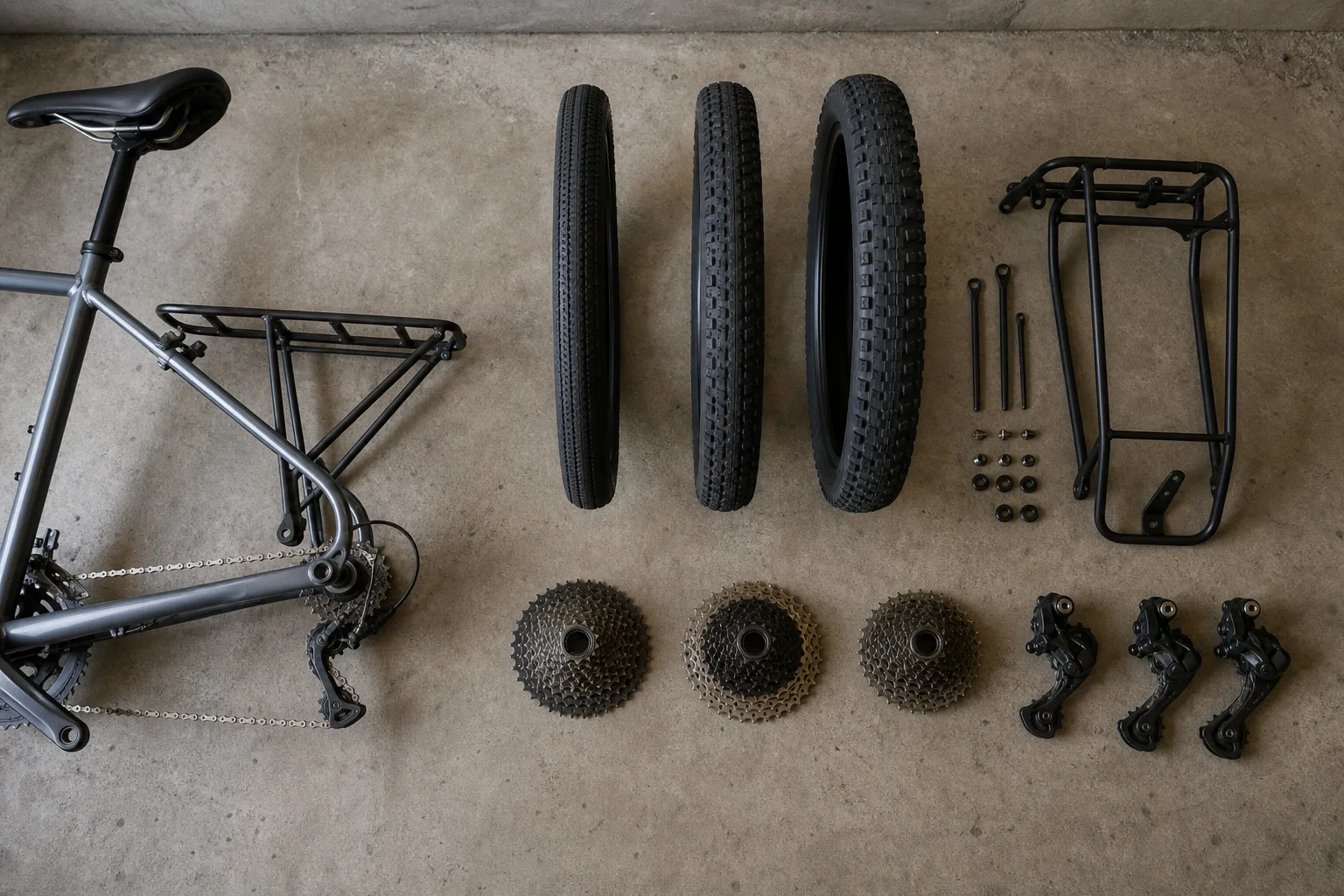
Tire width and gear range shape a commuting bike's ride far more than the frame material does, and both are printed on the spec sheet if you know where to look.
Two numbers on a spec sheet tell you more about how a commuter bike will feel than the word stamped on the down tube. The first is tire width in millimeters, the second is the spread between the easiest and hardest gear. Aluminum, steel and carbon all get discussed at length in shops, and the differences between them are real but small next to what happens when you move from a 32mm tire to a 45mm one, or from a single chainring to a double. Both numbers are printed. Both are checkable before you hand over money.
What each width actually does under you
A 32mm tire on smooth pavement feels quick and precise, holds a line through traffic, and transmits every seam and patch straight into your hands. Go to 38mm and the road noise drops noticeably, potholes stop being emergencies, and packed gravel becomes ordinary riding rather than an experiment. At 45mm the bike gets calm in a way that is hard to appreciate until you ride a rutted path or a stretch of frost-heaved asphalt at night with a loaded rack. The tradeoff is weight and a slightly duller response when you stand on the pedals from a stoplight.
Width also changes what pressure you can run, and pressure is where most of the comfort lives. A 32mm tire wants something in the high sixties to mid seventies psi for a rider of average weight, and drops feel harsh below that. A 38mm tire runs comfortably in the fifties, a 45mm in the low forties, and every psi you take out is suspension you did not have to buy. Check the sidewall for the manufacturer's stated range and check the rim's stated maximum width, because the frame clearance is only half the question.
Rolling resistance and one winter of punctures
The old assumption that narrower rolls faster holds only on glass-smooth surfaces at high pressure. On real roads, a wider tire at lower pressure deflects around the surface instead of lifting the rider over it, and the measurable losses even out or tip the other way. What does not even out is casing quality. A supple 38mm tire with a good puncture belt rolls better than a stiff, heavy 32mm commuter tire, and it costs roughly what you would expect for a decent pair at a shop counter, somewhere in the range of seventy to a hundred dollars for two.
Over one winter of salted, gritted, glass-strewn roads, the pattern was consistent. Flats clustered on the narrow, high-pressure setup, mostly pinch flats from unseen edges and a few slow leaks from wire fragments that a thin casing could not stop. The wider tires, run softer, went the season on one repair. That is one rider's experience rather than a study, but it matches the physics: more air volume means the tube is less likely to be crushed against the rim, and a belted casing takes the debris that a race tire is not built to take.
What a 1x gives up on hills
A single chainring drivetrain removes the front derailleur, the shifter and the chance of dropping a chain in the wet, and for flat commuting that is a real simplification. The cost is gear spacing. A 40-tooth ring with an 11-42 cassette gives you a usable low gear for most loaded climbs and a top gear that runs out around 25 miles per hour, with jumps between cogs large enough that you will sometimes sit between two cadences. A 46/30 double with an 11-34 cassette gives a lower bailout, a taller cruising gear and finer steps in the middle where you spend your time.
The way to check this without trusting a sales pitch is arithmetic. Divide the chainring teeth by the largest cog, multiply by the wheel diameter in inches, and compare the resulting number across bikes. Anything under about 25 will get you up a steep grade with groceries. If the route home includes a sustained climb, or you plan to tow a trailer, the double earns its extra cable. The Consumer Product Safety Commission oversees the safety standards bicycles sold here are built to, but nothing in those rules decides whether the gearing suits your hill.
What to check before you pay
Ask for the measured tire width on the actual rim, not the printed size, since a 38mm tire on a wide rim can measure past 40 and eat the clearance you were counting on. Ask what the frame takes with fenders fitted, which is usually a few millimeters less than bare. Ask for the cassette range and chainring sizes in writing. Then ride the bike over the worst hundred yards of pavement you can find near the shop, at the pressure you would actually run.
Get those two numbers right and the frame material becomes what it should be: a preference, not a decision you have to live with every morning.